Plan energy around charging demand

Solar and BESS Integration for EV Charging

Assess solar generation and battery storage against your charging load, electricity costs and resilience needs before selecting a system.

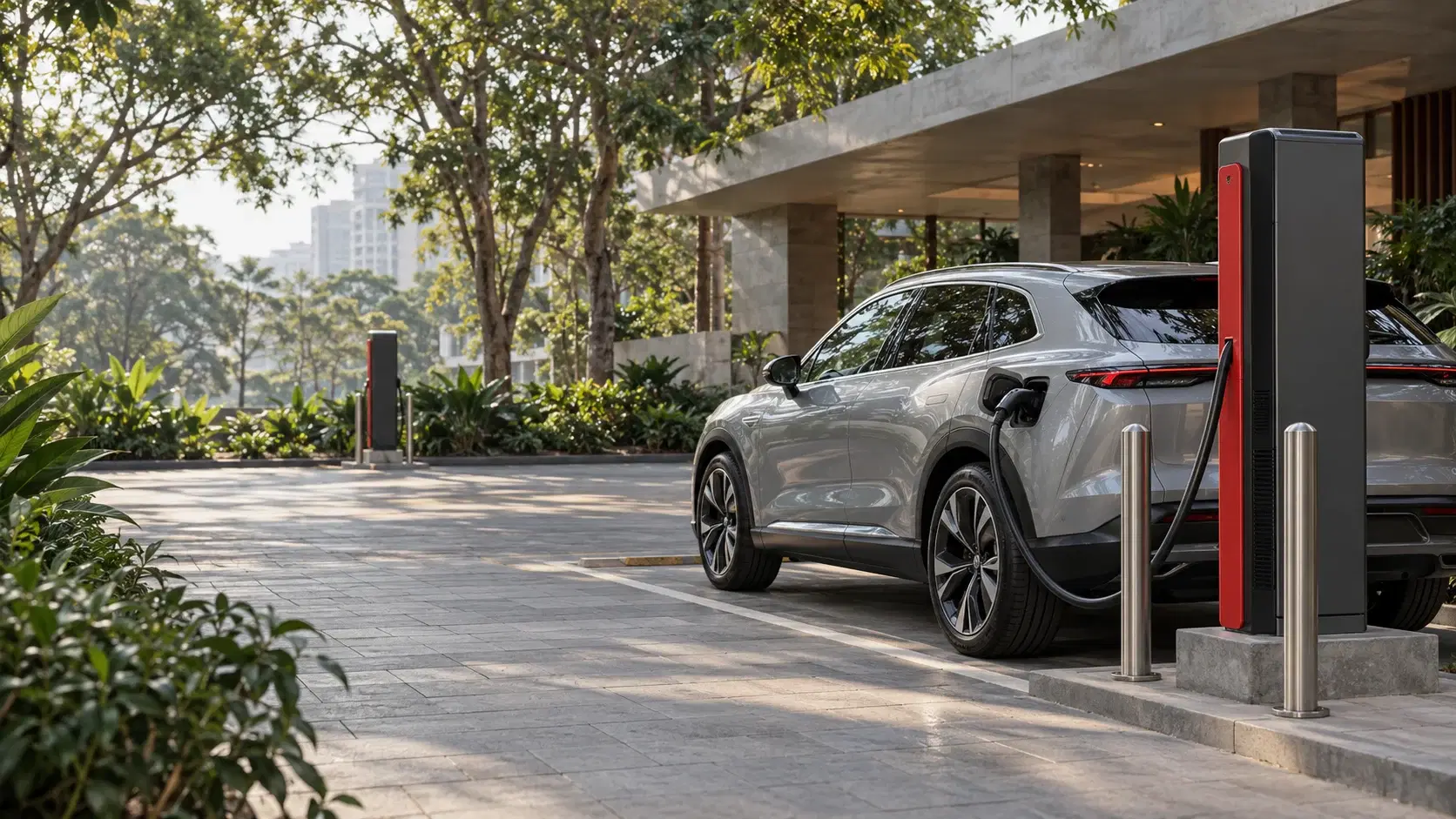
Illustrative Indian charging site with an electric car connected to a freestanding charger
Visualisation · Illustrative visualization · Not an EHUB installation

The starting point

Start with the load profile and the intended use of storage.

A battery used to manage short demand peaks has a different job from one supporting selected loads during an outage. Define the required power, duration and operating mode, then assess how solar and charging demand overlap throughout the day.

Designed for

Built around your setting.

The right charging approach depends on who uses the site, how long they stay, the available electrical capacity and who will operate the system.

Fleet depot owners
Institutions
Public charging operators
Commercial property owners

How it works

From site plan to daily use.

01

Size the system for the purpose

Use site demand data, charging schedules and solar generation estimates to compare system options. Account for usable battery capacity, efficiency and expected operating cycles.

  • Peak demand and duration
  • Solar output profile
  • Battery power and usable energy
  • Charging schedule
02

Review cost, safety and integration

Check electrical protection, controls, equipment location and maintenance needs. Backup capability and potential savings must be assessed for the proposed design and applicable tariffs.

  • Electrical and fire-safety review
  • Inverter and control compatibility
  • Maintenance and lifecycle costs
  • Site-specific financial assessment

Load-profile review

Solar assessment

Storage sizing

Control and safety design

Next step

Let’s talk about your site.

A few details are enough to begin. We can work through the technical questions together.

Let’s talk

Your project.
A conversation to start.

Tell the team your city, the kind of site you have in mind and what you want charging to make possible.

Project
Solar and Storage
Based in
Hyderabad, India

Email opens your email app; calling opens your phone app. You choose when to send or call.

Clear answers

Solar and Storage FAQ

Is storage necessary for solar EV charging?+

Not always. Charging that coincides with solar production may use generation directly through a suitable site design. Storage should be considered only where its operating purpose and costs make sense.

Can BESS replace a grid upgrade?+

It may help manage some demand peaks, but it cannot be assumed to replace the required electricity capacity. Feasibility depends on charging demand, recharge time, storage capacity and the electrical design.

Will battery storage guarantee lower costs?+

No. The result depends on tariffs, utilization, losses, equipment cost and maintenance or replacement needs. Compare the full lifecycle costs of the proposed options.